Curriculum
Entrepreneurship is a learn-by-doing discipline. However, there are skill sets that are needed in order to fully jump into the world of starting a new venture or pushing new initiatives through an existing company.
ESTEEM's curriculum has been specifically designed to build technical and business skills through the lens of entrepreneurship, delivered by faculty members who have lived it. At the end of the program, students are granted a Master of Science (M.S.) in Engineering, Science and Technology Entrepreneurship.
Unlike other programs that may rely heavily on weekly assignments or midterm and final projects to show students how to apply their skills, the ESTEEM Program has strategically integrated its curriculum with a year-long capstone project. The ESTEEM capstone project serves as a real-world sandbox where students take their classroom skills and apply them to an actual technology commercialization effort. The timeline of the capstone project matches the sequence of classes throughout the year and, in many cases, assignments in class are used to advance a student's capstone project.
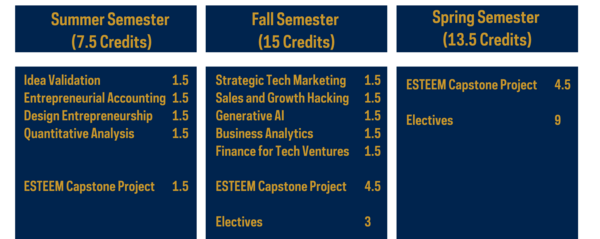
The curriculum is divided into three parts, which take place over the course of three semesters (Summer, Fall, Spring):
· Core Courses: These are the courses students take together as a cohort, covering entrepreneurship and business fundamentals.
· Electives: Each student is required to take 12 credit hours of elective. Of these 6 credit hours must be teachincal electives that build on their technical background, oftentimes directly related to their capstone project.
· Capstone Project: The capstone project is also a formal part of their curriculum.
In order to graduate students must take a total of 36 credits
- 13.5 credits in Core Classes
- 10.5 credits in the Capstone Project
- 12 credits in Electives, of which 6 must be technical
For the 2025-2026 academic year important dates are as follows:
· ESTEEM Opening Activity: June 16 - 17
· ESTEEM Orientation: June 18
· Summer Semester: June 19 - August 1
· Graduate School Orientation: August 18 - 19
· ESTEEM Alumni Panels: August 20 - 22
· Fall Semester: August 25 - December 18
· Mid-term Break: October 20 - 24
· Spring Semester: January 12 - May 8, 2026
· Mid-term Break: March 8-12, 2026
· Commencement Weekend: May 15 - 17, 2026

Summer Semester
-
(Core) Entrepreneurial Accounting - ESTM 63606
The Entrepreneurial Accounting Course is focused upon the basic concepts and standards underlying financial accounting systems as they relate to entrepreneurship. Several important concepts will be studied in detail, including: revenue recognition, inventory, long-lived assets, present value, and long term liabilities. The course emphasizes the construction of the basic financial accounting statements: the income statement, balance sheet, and cash flow statement.
Faculty: Michael Meyer
-
Capstone Project (Summer) - ESTM 68303
This course is the completion of the Thesis Project for the ESTEEM program. The end result is a thesis that describes in depth the intellectual property/technology embodied in the thesis project, applications, commercialization of the technology and culminating in a business plan.
Faculty: Ellen Dutton, Germán Estrada Mendoza
-
(Core) Design Entrepreneurship - ESTM 61201
Visualization can be a powerful way to inspire confidence in investors. This process-based course introduces various techniques to communicate design intent. Topics covered include: rapid visualization, product development, user experience, works and looks-like prototyping, infographics and data-visualization, design narrative, photo and video editing, and process documentation. Through experience and tangible outcome, students will obtain a measurable shift in their understanding of product development, while improving presentation skills and aesthetic judgment. The goal of this course is not to turn ESTEEM students into designers, but to instruct them on the importance of design decisions to the product development process.
Faculty: Ann-Marie Conrado
-
(Core) Quantitative Analysis: Making Actionable Insights from Data - ESTM 60235
This course is designed for aspiring entrepreneurs who want to learn how to leverage the power of spreadsheets to perform quantitative analysis, which informs and empowers them to make smart, data-driven decisions. We will focus on using spreadsheets (Microsoft Excel and Google Sheets) to learn the core concepts for gathering, organizing, and visualizing data to make actionable insights from data. Through a combination of lectures, readings, video tutorials, and hands-on exercises, students can design advanced spreadsheets and other analytical tools, including pivot tables and data dashboards, that turn data into impactful information that is meaningful for themselves and their stakeholders.
Faculty: Randal Harrison
-
(Core) Idea Validation - ESTM 60236
Students will learn how to conceive business ideas from problems without clearly defined structures. They will build the ability to explore issues/problems through someone else's eyes to identify needs and wants, design a business idea and test it. The course will complement the Design Entrepreneurship course, which focuses on customer discovery.
Faculty: Germán Estrada Mendoza
Fall Semester
-
(Core) Finance for Tech Ventures - ESTM 63607
This practical course prepares aspiring tech entrepreneurs and innovation leaders to navigate uncertain business environments. Students will 1) build simple but functional financial models without historical data, 2) implement effective cash flow strategies, and 3) apply valuation methods focused on value creation. Using real tech company case studies, students will develop skills to make informed financial decisions that drive growth and enhance stakeholder value. The course bridges essential financial principles with practical applications, providing valuable tools for building successful technology businesses.
Faculty: Germán Estrada Mendoza
-
(Core) Strategic Tech Marketing - ESTM 60102
The Technical Marketing course will focus on the application of modern marketing techniques in the design, development, and commercialization of embryonic and high risk technologies. Core marketing principles, models, theories, and frameworks will be explored. The use of these principles in the context of the innovation cycle, from invention to venture for start-up companies and from invention through commercialization in established companies, will be emphasized.
Faculty: Michael Kitz
-
(Elective) Business and IP Law for Entrepreneurs - ESTM 60105
This course introduces the entrepreneur, whether as a startup or part of a large company, to the intellectual property and business law issues facing a new business. It will address how to protect your business idea from copying through patents, trade secrets and other IP, why and how to form a legal entity, equity investments and other founder issues, managing risks, privacy issues, and some of the legal issues facing the use of AI. The course uses many interactive activities, team-based assignments, and applications of these issues to your capstone projects.
Faculty: James Farrington
-
(Core) Business Analytics - ESTM 60210
Commonly called “the new gold”, data is becoming one of the most valuable assets to organizations. However, raw data does not hold much value until it is appropriately processed into information. This course provides a comprehensive introduction to business analytics- essential concepts, techniques, and tools for data-driven decision-making. Students will learn how to collect, clean, analyze, and interpret data to solve real-world business problems. Practical skills will be developed through hands-on exercises and projects to prepare students for a variety of business environments- from startups and consultancies to medium and large corporations.
Faculty: Valya Kuskova
-
(Core) Sales and Growth Hacking - ESTM 60219
The goal of this modern sales course is to demystify sales and help students build the confidence, competence, and strategies to succeed within entrepreneurial environments. While the focus will be on startups, this course is applicable for students who may end up in sales, venture capital, consulting, or other similar fields within companies of all sizes. Students will acquire a thorough understanding of how to coordinate marketing and sales strategies to effectively build their Go-To-Market Strategy. This course covers the fundamentals of sales and how to build a sales process that consistently wins new business. Students will leave with the skills and confidence to conduct effective business development outreach, run effective sales meetings, and close new business. We will also explore case studies on growth hacking from leading companies such as HubSpot, Airbnb, and others. By the end of this course, students will be equipped with a stronger understanding of their sales strategies and enhanced confidence in their selling abilities.
Faculty: Brian Bar
-
Capstone Project (Fall) - ESTM 68302
This course is the second phase (of a total of three courses) to complete the ESTEEM Thesis Project. After extensive research, students produce a technology report that presents the technical foundations of the project. Next, students explore market and intellectual property issues. Once our students gain a firm understanding of the project's context, they then create a series of hypotheses related to the business model. The students next test these hypotheses via stakeholder interviews. Finally, students complete a formal presentation to a committee of professors and project sponsors.
Faculty: Ellen Dutton, Germán Estrada Mendoza
-
(Tech Elective) Digital Persuasion Science - ESTM 60227
Software is eating business, and the web is taking over the world of software. Today’s tech entrepreneur lives in an exciting time when one no longer requires a large team of engineers to launch a SaaS (software-as-a-service) or app startup. A single person with a great idea and grit can bring a product to market and begin selling online.
Faculty: Michael Wicks
-
(Core) Current State and Future of Generative AI - ESTM 60244
This course aims to provide students with an understanding of the current state of AI and future trends. It will also delve into useful AI tools which students can leverage to improve and work on their startups. It will also explore the ethical and legal implications associated with generative AI.
Faculty:
-
(Tech Elective): Object Design and Fabrication - ESTM 61000
Students will become certified users of Solidworks design software while gaining fundamental knowledge on object fabrication modalities including 3-D printing and CNC milling.
Faculty: Matt Leevy
-
(Tech Elective) Launching Physical Products - ESTM 60241
ESTEEM’s mission statement is to deliver its vision by building the most realistic entrepreneurial sandbox in higher education in which students will create, design, build, fail, pivot, iterate, and perhaps even launch and scale, all with a focus on fixing things that matter. This course is designed to give you this sandbox in which to experiment with an idea. The course is designed with 3 segments in mind. First, students will spend time diving into customer discovery, competitive research, and trends research. Second, they will spend time in research and development by scoping a project, putting together a team, translating the Voice of the Consumer to the Voice of Engineering, and customer validation. Third, the students will focus on prototyping, legal and claims review, engaging marketing teams for launch materials, passing toll gates, and launching the product. This course will review these topics from the lens of a corporate intrapreneur and also a start up entrepreneur.
Faculty: Ellen Dutton
-
(Tech Elective) Product Market Fit Lab - ESTM 60238
The Product Market Fit Lab is designed for aspiring founders of tech startups who are ready to turn their insights into viable businesses. This hands-on course focuses on teaching and applying proven methods to achieve Product Market Fit (PMF) for startups. Teams will learn how to validate their ideas, identify ideal customer profiles, position their offerings effectively, and develop compelling messaging that resonates with target markets. Throughout the semester, teams will run experiments that test their hypotheses and refine their approach based on real-world feedback. Upon instructors' approval, teams will be provided resources to run experiments. Experiments should be focused on testing the value hypothesis, not on growth. At the end of the course, the successful teams would be eligible for additional funding based on course performance and delivery of the final project. The instructional approach is hands-on, experiential learning. Teams will apply concepts in real-time, receive direct feedback, and iterate based on actual market responses. Prerequisites - Teams must apply and be accepted to participate - At least one team member must have technical building capabilities - All teams must bring a specific insight or hypothesis to explore - Teams must commit to following the course methodology, even when it challenges conventional wisdom.
Faculty: Germán Estrada Mendoza, John Vrionis
Spring Semester
-
(Elective) Corporate Innovation - ESTM 63608
The ability to innovate is crucial for business survival and growth in the current climate of rapid technological advancement and changing consumer preferences. Without innovation and entrepreneurship skills, more and more companies are failing when faced with market challenges. In this course, you will develop the knowledge and skills necessary to encourage innovation and entrepreneurship into the strategy, capabilities, and culture of an organization.
Faculty: Mike Bechtel
-
(Elective) Funding New Ventures - ESTM 60215
This course examines methods that an entrepreneur would consider for financing an early stage venture. Topics include bootstrapping, microloans, bank debt, crowdfunding, angel investment, and venture capital funding. Students learn how to formulate a funding strategy for an early stage business, prepare financial projections, create a plan for use of funds, and gather appropriate and complete materials for due diligence by a lender or equity investor.
Faculty:
-
(Elective) Product Management for Startups - ESTM 60203
Product management sits at the intersection of engineering, design, and business strategy. This class explores the product development lifecycle through the cash-strapped lens of start-ups. Entrepreneurs and intrapreneurs can expect to learn relentlessly practical and fluid execution strategies for delivering hardware and software products given new and uncertain markets. In this course you will learn some techniques for prototyping, testing, and delivering products the quick and dirty way. Through readings, lectures, case-studies, and real-world demonstrations students will be exposed to the realities of product execution.
Faculty: John Flatley
-
(Elective) Social Entrepreneurship - ESTM 60223
Social Entrepreneurship will be a seminar style class with an emphasis on readings, classroom discussion/presentation and case study analysis. The course will examine 1) The history of the social enterprise movement and this form of "disruptive innovation;" core definitions and debates around around definition; challenges to its effectiveness and sustainability, 2) For-profit and non-profit structures (similarities and differences); Hybrid-structures; Earned Income strategies; B-Corporations, 3) The Bottom of the Pyramid (BOP): Engaging the Poor as Consumers and Producers, 4) Micro-Enterprise Development and Micro-Finance Models, and 5) Funding Social Enterprises and Impact Investing.
Faculty: David Murphy
-
Capstone Project (Spring) - ESTM 68302
This course is the second phase (of a total of three courses) to complete the ESTEEM Thesis Project. Students prepare a comprehensive commercial launch strategy that addresses the core aspects of the proposed business model. Students also produce a detailed financial forecast to support the launch strategy. Additionally students continue to conduct stakeholder interviews as they refine the launch strategy. The semester and program culminates in a final formal presentation that details the work the student has done on the capstone project.
Faculty: Ellen Dutton, Germán Estrada Mendoza, Sam Miller
-
(Tech Elective) Innovation in Cancer Research - ESTM 60228
This course will begin by exploring the fundamental hallmarks of cancer. Once the foundation has been laid for a general understanding of what cancer is, you will be introduced to a wide array of cancer research that is being done at the Harper Cancer Research Institute (HCRI). This showcase of HCRI's research will serve as an introduction to the innovative and integrative research efforts that the dedicated researchers are conducting to confront the complex challenges of cancer. In the spirit of entrepreneurship, this course will also highlight cancer research that has led to startup formation and commercialization. By the end of the course, students should have a broad understanding of what cancer is and what is being done to understand and treat it at Notre Dame as well as in general.
Faculty: Khoa Huynh
-
(Tech Elective) Tech Startup Sprint Series -
The Startup Sprint Series is an intensive, hands-on, project-based course in which student teams design and test new business concepts that address real-world needs.
Faculty: Germán Estrada Mendoza, John Vrionis
-
(Tech Elective): Object Design and Fabrication - ESTM 61000
Students will become certified users of Solidworks design software while gaining fundamental knowledge on object fabrication modalities including 3-D printing and CNC milling.
Faculty: Matt Leevy
-
(Tech Elective) Data Science - ESTM 60242
This introductory course is designed to provide students with the fundamental knowledge and skills necessary to understand and apply data science concepts and techniques in industry contexts. Students will learn the principles of data manipulation, visualization, statistical analysis, and machine learning, with a focus on practical applications. Through hands-on projects and real-world examples, we will provide the foundation needed to leverage data-driven insights in practical problem-solving. We will cover basic applications of analytics, machine learning / AI, network data and the principles of data visualization for both complex and simple data.
Faculty: Matthew Sisk, Valya Kuskova
-
(Tech Elective) BioTech - ESTM 60247
This course offers an in-depth exploration of the biotechnology ecosystem, covering the entire cycle, from drug discovery and development to commercialization. Students will learn about key industry sectors, including large and mid-sized pharma, biopharma, research institutions, and regulatory bodies. The course examines the entire drug development process, regulatory strategies, intellectual property management, and emerging fields like gene therapy and diagnostics. It also addresses critical aspects of biotech entrepreneurship, such as financing, team building, and strategic partnerships.
Faculty: Mike Flavin
Join Us
Start your entrepreneurial journey with ESTEEM. Begin your application or learn more about our program.